Mass
Mass
A rare jewel of Baroque music is heard: the Missa votiva of Jan Dismas Zelenka (1679–1745), together with works by Tomás Luis de Victoria (c. 1548–1611).
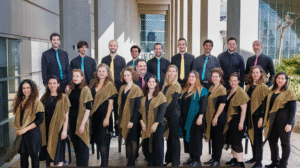
Performers: the Moran Choir (from Israel) and the Hortus Musicus Baroque Orchestra.
Conductors: Tom Karni and Andres Mustonen.
The Moran Choir Studio comprises six choirs and about 200 singers aged from 5 to 60. The studio was founded in 1986 by Naomi Faran. Five generations have now received their choral education there.
The Moran Singers Ensemble is made up of choir alumni, outstanding musicians, and students and graduates of several music academies. Its repertoire includes both classical music and newer Israeli choral music by leading composers such as Gil Shohat, Menachem Weisenberg, Haim Permont, Yehezkel Braun, Noam Sivan, Eyal Batt, Zipi Fleisher and Joseph Bardanashvili.
The choir has performed with distinguished ensembles including the Kibbutz Chamber Orchestra, the Rishon LeZion Orchestra, the Tel Aviv Soloists Ensemble, the Israel Chamber Orchestra, the Israel Camerata and the Israeli Opera, and has taken part in competitions and international festivals, among them the Bach Festival in Eugene (Oregon, USA), Musica Sacra in Germany, Vox Pacis in Stockholm, an international choral festival in Argentina and the Zemplén Festival in Hungary.
Under the conductor Tom Karni the choir has sung, among other works, music by Arvo Pärt and Pärt Uusberg.
In February 2025 the choir performed Zelenka’s Mass with the ensemble Barrocada under Andres Mustonen in five cities in Israel.
The following note is taken from that programme:
The Bohemian composer Jan Dismas Zelenka has been regarded as one of the most underrated, and at the same time most remarkable, figures of the Baroque. A prolific composer of church and instrumental music, he wrote hundreds of works that were innovative and original in style, drawing attention for their complex polyphony, bold harmony, virtuosity and traces of Czech folk music. After his death Zelenka fell into oblivion and was “rediscovered” only at the end of the 19th century, led by Bedřich Smetana. The Missa votiva was written at a creative peak, while he was working in the court chapel in Dresden. An exceptionally heavy workload in the 1730s damaged the composer’s health severely and in the end hindered composition, but by 1739 Zelenka had recovered. Regarding this as a divine miracle, he wrote the mass in thanks to God for his recovery. The Missa votiva is one of the largest works in Zelenka’s output. It is scored for four soloists, choir and a string orchestra supplemented by trumpets and bassoon. The composer does not stop at the six principal sections of the mass, but divides them into smaller sections of differing character. The result is a large-scale work embracing choral scenes, arias, chorales, dramatic passages and fugues.